
Complete Response Letters (CRLs) remain one of the most informative, yet often underutilized, sources of regulatory intelligence available to the pharmaceutical industry. Although typically viewed through the lens of delayed approvals, these letters provide valuable insight into the U.S. Food and Drug Administration's evolving expectations regarding product quality, clinical evidence, benefit-risk assessment, and patient safety. For professionals working in Drug Safety and Pharmacovigilance, CRLs offer an opportunity to examine regulatory decision-making beyond the binary outcome of approval or non-approval.
The FDA's decision in July 2026 to temporarily suspend the real-time publication of new Complete Response Letters while reviewing its transparency policy has reduced the immediate availability of regulatory feedback. Nevertheless, the publicly disclosed CRLs during the first half of 2026 continue to illustrate recurring themes that extend beyond individual products and therapeutic areas. They reinforce an increasingly important principle in modern drug development: pharmacovigilance is no longer confined to post-marketing surveillance but has become a critical determinant of regulatory success throughout the product lifecycle.
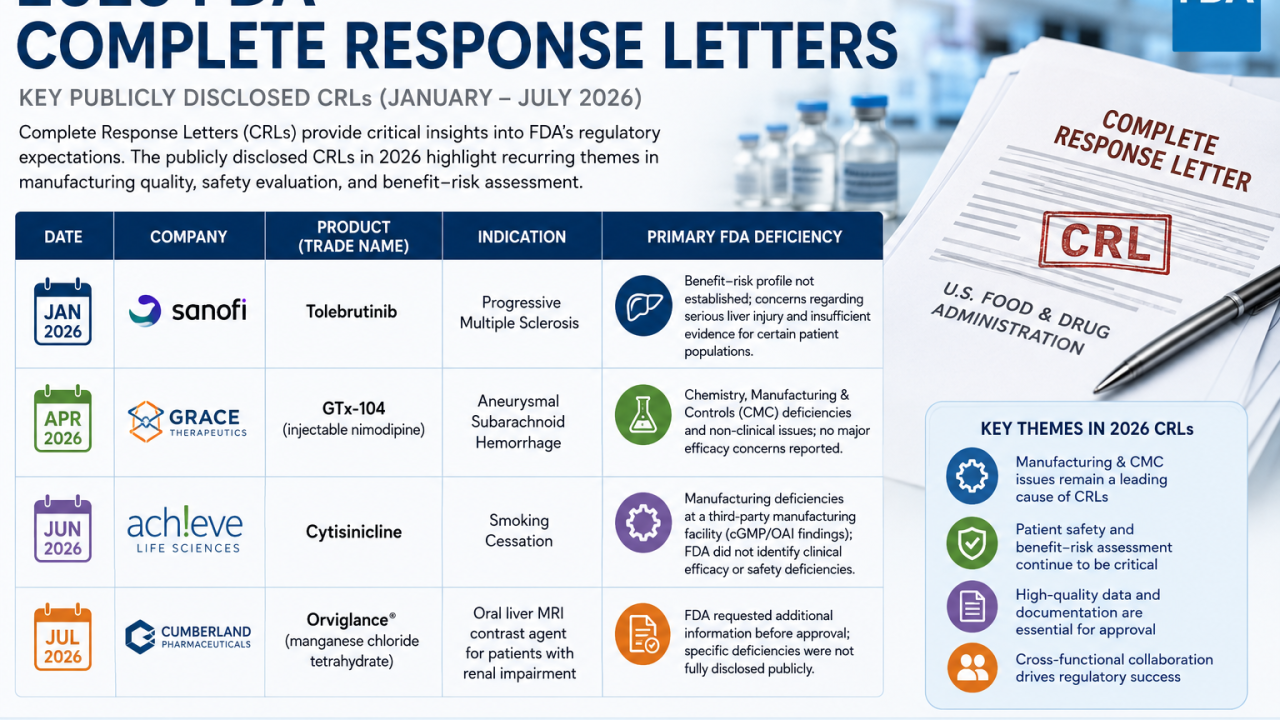
The Complete Response Letter issued to Achieve Life Sciences for cytisinicline illustrates this evolution. The FDA did not identify deficiencies related to the product's clinical efficacy or safety profile. Instead, the agency cited manufacturing deficiencies identified during inspection of a third-party manufacturing facility. Although the primary observations fell within Chemistry, Manufacturing and Controls (CMC), the broader implications are highly relevant to pharmacovigilance. Manufacturing quality directly influences the safety of medicines by affecting product consistency, impurity profiles, stability, and dose reliability. Variability introduced during manufacturing may ultimately manifest as quality defects, medication errors, reduced therapeutic effectiveness, or unexpected adverse events once a product reaches patients. Consequently, the traditional distinction between manufacturing quality and drug safety is becoming increasingly artificial. Effective pharmacovigilance requires an understanding of how quality systems influence clinical outcomes.
A similar regulatory theme emerged in the FDA's Complete Response Letter to Grace Therapeutics for GTx-104. Publicly available information indicated that the agency's concerns primarily involved CMC and non-clinical deficiencies rather than inadequate clinical efficacy. This case reinforces the concept that successful regulatory submissions depend upon the maturity of the entire development program rather than any single discipline. Product quality, analytical validation, manufacturing robustness, and clinical evidence collectively determine regulatory confidence. Pharmacovigilance professionals therefore benefit from participating in multidisciplinary discussions that extend well beyond traditional adverse event evaluation.
Cumberland Pharmaceuticals also announced receipt of a Complete Response Letter for Orviglance®, an oral MRI contrast agent developed for liver imaging in patients with renal impairment. Although the detailed contents of the FDA's letter were not publicly disclosed, the case highlights another important aspect of regulatory science. Uncertainty itself is a regulatory risk. Sponsors must anticipate questions regarding safety characterization, clinical relevance, product quality, and risk mitigation before submission rather than relying upon iterative responses after review has begun. Comprehensive safety documentation and scientifically coherent benefit-risk narratives remain fundamental components of regulatory readiness.
Collectively, these cases demonstrate that regulatory agencies increasingly evaluate medicinal products through an integrated framework that combines clinical efficacy, clinical safety, pharmaceutical quality, manufacturing reliability, and long-term risk management. This holistic approach reflects the reality that patient safety cannot be compartmentalized into isolated regulatory functions. Rather, it emerges from the interaction of clinical development, manufacturing science, pharmacovigilance, epidemiology, regulatory affairs, and quality systems.
This evolution has important implications for pharmacovigilance practice. The traditional focus on processing Individual Case Safety Reports remains essential but is no longer sufficient. Modern pharmacovigilance increasingly emphasizes proactive signal detection, cumulative medical assessment, quantitative benefit-risk evaluation, and integration of evidence generated across clinical trials, observational studies, spontaneous reporting systems, literature surveillance, and real-world data. Safety scientists are expected not only to identify adverse reactions but also to interpret their clinical significance within the broader therapeutic context.
Equally important is the quality of regulatory communication. High-quality safety analyses lose much of their value if they are not presented in a manner that allows regulators to understand the overall safety profile of the product. Integrated Summaries of Safety, Clinical Study Reports, Risk Management Plans, Investigator Brochures, prescribing information, and medical narratives should collectively describe a consistent scientific narrative supported by transparent methodology and robust evidence. In this respect, pharmacovigilance contributes not only data generation but also scientific interpretation.
Another notable observation emerging from recent CRLs is the increasing convergence of pharmacovigilance and regulatory strategy. Historically, regulatory affairs managed submissions while pharmacovigilance focused primarily on safety surveillance. Contemporary drug development requires these disciplines to function as strategic partners. Decisions regarding study design, endpoint selection, safety monitoring, statistical analyses, labeling strategy, and post-marketing commitments all depend upon continuous interaction between regulatory and safety teams. Organizations that establish these collaborations early are more likely to anticipate regulatory concerns before submission.
The temporary suspension of real-time CRL publication should not diminish the value of regulatory transparency. On the contrary, the publicly available letters continue to provide an important educational resource for industry, regulators, and academic researchers. Systematic evaluation of regulatory deficiencies allows organizations to benchmark internal practices, identify recurring challenges, and strengthen future development programs. In this sense, each Complete Response Letter represents not merely a regulatory outcome but a contribution to collective scientific learning.
Ultimately, the lessons emerging from the publicly disclosed Complete Response Letters of 2026 extend well beyond the products involved. They underscore that regulatory success is determined not by isolated datasets but by the credibility of the overall scientific evidence supporting a medicine. For pharmacovigilance professionals, this reinforces a broader transformation of the discipline. Drug Safety is no longer defined solely by adverse event reporting. It has become an integrated scientific function responsible for informing benefit-risk decisions, supporting regulatory strategy, strengthening product quality oversight, and ultimately ensuring that patients receive medicines whose safety and effectiveness are supported by the highest standards of evidence.
As regulatory science continues to evolve, pharmacovigilance will remain central to translating complex safety data into informed regulatory decisions. The lessons from 2026 serve as a timely reminder that excellence in drug safety is achieved not through reactive compliance but through scientific rigor, multidisciplinary collaboration, and an unwavering commitment to patient welfare.
To learn more from related topics, please visit our website or newsletter at https://medipharmsolutions.com/newsletter/
No Comments