The drug safety landscape is undergoing its most profound transformation in a generation. AI agents, large language models, and real-world data pipelines are reshaping how we detect, assess, and communicate safety signals — and the professionals who thrive will be those who blend deep domain expertise with technological fluency.
Why Now?
Pharmacovigilance was built on manual processes: reading narratives, coding MedDRA terms, writing ICSRs, and drafting periodic reports. For decades, the bottleneck was human capacity. Today, AI is removing that bottleneck — but it is simultaneously raising the bar for what it means to be a drug safety expert.
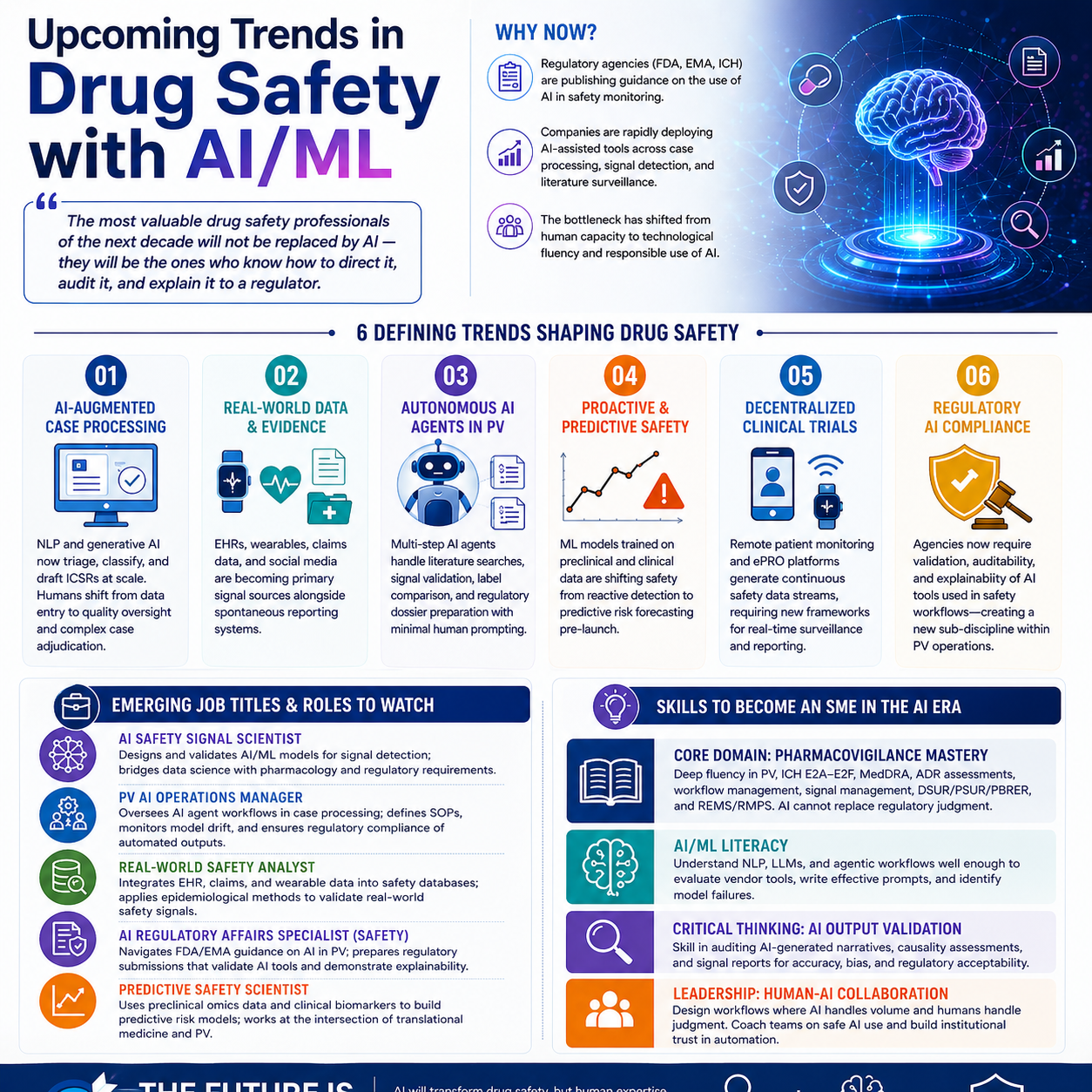
Regulatory agencies including the FDA, EMA, and ICH are actively publishing guidance on the use of AI in safety monitoring. Companies that once lagged in digital transformation are now racing to deploy AI-assisted case processing, signal detection, and literature surveillance. The question for every safety professional is no longer if AI will affect your role — it's how quickly and how deeply.
"The most valuable drug safety professionals of the next decade will not be replaced by AI — they will be the ones who know how to direct it, audit it, and explain it to a regulator."
5 Defining Trends Shaping Drug Safety
Trend 01
AI-Augmented Case Processing
NLP and generative AI now triage, classify, and draft ICSRs at scale. Humans shift from data entry to quality oversight and complex case adjudication.
Trend 02
Real-World Data & Evidence
Electronic health records, wearables, claims data, and social media are becoming primary signal sources alongside spontaneous reporting systems.
Trend 03
Autonomous AI Agents in PV
Multi-step AI agents handle literature searches, signal validation, label comparison, and regulatory dossier preparation with minimal human prompting.
Trend 04
Proactive & Predictive Safety
Machine learning models trained on preclinical and clinical data are shifting safety from reactive detection to predictive risk forecasting pre-launch.
Trend 05
Decentralized Clinical Trials
Remote patient monitoring and ePRO platforms generate continuous safety data streams, requiring new frameworks for real-time surveillance and reporting.
Trend 06
Regulatory AI Compliance
Agencies now require validation, auditability, and explainability of AI tools used in safety workflows — creating a new sub-discipline within PV operations.
Emerging Job Titles & Roles to Watch
AI Safety Signal Scientist
Designs and validates AI/ML models for signal detection; bridges data science with pharmacology and regulatory requirements.
PV AI Operations Manager
Oversees AI agent workflows in case processing; defines SOPs, monitors model drift, and ensures regulatory compliance of automated outputs.
Real-World Safety Analyst
Integrates EHR, claims, and wearable data into safety databases; applies epidemiological methods to validate real-world safety signals.
AI Regulatory Affairs Specialist (Safety)
Navigates FDA/EMA guidance on AI in PV; prepares regulatory submissions that validate AI tools and demonstrate explainability.
Predictive Safety Scientist
Uses preclinical omics data and clinical biomarkers to build predictive risk models; works at the intersection of translational medicine and PV.
Skills to Become an SME in the AI Era
The competency stack that separates practitioners from subject matter experts
Core Domain
Pharmacovigilance Mastery
Deep fluency in basic concepts of PV, ICH E2A–E2F, MedDRA, ADR assessments, Work flow management, signal management, DSUR/PSUR/PBRER, and REMS/RMPS. AI cannot replace regulatory judgment.
AI/ML Literacy
Understand NLP, LLMs, and agentic workflows well enough to evaluate vendor tools, write effective prompts, and identify model failures.
Critical Thinking
AI Output Validation
Skill in auditing AI-generated narratives, causality assessments, and signal reports for accuracy, bias, and regulatory acceptability.
Leadership
Human-AI Collaboration
Design workflows where AI handles volume and humans handle judgment. Coach teams on safe AI use and build institutional trust in automation.
Compliance
AI Governance & Ethics
Apply 21 CFR Part 11, GAMP 5, and emerging AI regulatory guidance. Understand algorithmic bias and data privacy implications in safety data.
How to Build This Skill Stack
The good news: you don't need a computer science degree. The best AI-era safety professionals are domain experts who invest strategically in adjacent skills. Start by developing AI literacy — take a short course on how LLMs work, experiment with generative AI tools in your daily workflow, and learn to write clear, structured prompts that produce auditable outputs.
Next, pursue data fluency. You don't need to build models — you need to understand data pipelines well enough to ask the right questions and interpret outputs critically.
Finally, lead on governance. Professionals who can bridge clinical judgment, AI capability, and regulatory expectation will define the next generation of PV leadership.
The Bottom Line
AI agents will transform pharmacovigilance operations — dramatically increasing throughput, reducing error rates in routine tasks, and enabling surveillance at a scale previously impossible. But the need for sound medical and scientific judgment, regulatory expertise, and ethical oversight is not diminishing. It is becoming more concentrated, more visible, and more critical.
The drug safety professionals who invest now in understanding AI — not to become engineers, but to become informed directors of AI — will find themselves in extraordinary demand across pharma, biotech, CROs, and regulatory agencies worldwide.
The future of patient safety depends on getting this right. And that means you at the center of it.
To learn more from related topics, please visit our website or newsletter at https://medipharmsolutions.com/newsletter/
No Comments